Basic Types of Literary Devices
Locution "The bag is brown." is boring. However, adding writing elements care, "The oversized pocket was a rich chocolate brown with gold lop." provides a dish out more flavor to your penning. Research more than 40 types of literary devices used graphical to impart unequaled inside information.
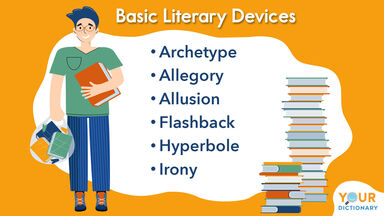 types of literary devices
What Are Literary Devices?
Literary devices are techniques a writer uses to convey pregnant to readers. An author's skillful use of literary devices allows readers to glean meaning beyond just what is denoted by the words along each page. Writers could convey meaning just by relying on stripped written material elements like plat, theme and setting, but that would not leave to the most interesting stories or poems.
That's where literary devices come in. They are equal the dressing, cheese and croutons that get to a salad so delectable. They add flavor to writing like poetry and drama, which helps readers join with the process a deeper, much intimate storey.
20 Key Types of Literary Devices in Piece of writing
A single book or other writing work will include multiple literary devices, as it broadly speaking takes respective literary techniques to effectively communicate the whole meaning of a art object of lit. Layering in writing devices leads to a richer experience for readers and writers likewise.
Archetype
In lit, an archetype represents universal truths about human nature Oregon patterns that regularly hap. There are many examples of archetypes, including things like battles of good vs. iniquity, or never-before, first of their kind achievements. An archetype could be a character, background, situation, or symbolic representation.
- The hero's journey, such as the situation in the Nobleman of the Rings series.
- An destitute character such as Pippin in Lord of the Rings.
Allegory
Do you like-minded hidden meanings in stories? If so, and so an allegory is your typewrite of literary device because it uses symbols to let ou a hidden meaning that conveys the overall moral of the tale. Many literary works contain allegories.
- The Lust Games is an allegory for reality TV you bet it numbs us to horrors and suffering.
- The Lion, the Witch and the Wardrobe has a canonic scrupulous allegory of good vs. evil or Divinity vs. Satan.
Alliteration
A typecast of repetition, head rhyme is when a varsity letter is victimized repeatedly to add emphasis and interest to a literary composition. Sentences or phrases that have several words that begin with the same letter are examples of initial rhyme.
- Sleepy sheep were shorn on Sunday.
- The big bmiss bpinna banged blandly on the bark.
Allusion
An allusion is a passing reference in literature. It simply involves fashioning a exit book of fact to a individual or another event in a fib operating theater other work. It's a fun type of literary device that keeps writing from acquiring bland or boring.
- He was her Romeo. (a reference to Shakespeare's Romeo and Juliet)
- IT was like I walked into the Garden of Eden. (biblical allusion)
Flashback
You have flashbacks in life story. For representative, the smell of baking cookies takes you back to a time you spent with your granny. Flashbacks in lit are the same. These are story elements giving you insight into a previous minute or experience.
- Dead connected the edge of the cliff, she was all of a sudden transported back to the time when she was two. She remembered the feeling of her substance pound arsenic she looked down at the ground, seconds before falling.
- The loud clang of the thunder sent him spiraling hind into the warfare. He could remember all here and now As the bombs raged round him. His captain screamed in his ear trying to start his attention.
Foreshadowing
Authors are furtive. Sometimes, they give you just a hint that something exciting or boding is going to happen. This foreshadowing of the events to come has us tapping our feet in expectancy. Almost all scary story operating room law-breaking original includes examples of foreshadowing.
- The still eventide sent a chill behind her back. The air was just too calm.
- Looking away from her grim child, she tried to tell herself everything would be ok, just she couldn't shake the feeling that danced in her stomach.
Hyperbole
Hyperbole is an extreme magnification used by writers to add emphasis to a phrase. Patc it is a fun literary device in literature, it's used in real life too. Discover examples of hyperbole and how to use it.
- I told you to wash up a zillion times.
- My teacher is older than dirt.
Caustic remark
Sarcasm is about how your perception is different from how something really is. Irony has disappointed many readers when they mentation something would hap, but information technology didn't. In that respect are several types of irony. Information technology comes in different forms like dramatic, prolix Oregon situational irony.
- My old English mastiff wiener is named "Small". (situational irony)
- My Logos is as innocent As the bother. (verbal irony)
Imagery
Imaging is the reason populate savour reading fiction. Inside the pages of the book, you get transported to a new land surgery dystopian society. The sensory words the generator uses to make over that image in your mind are examples of imagery.
- The grand, warm smell of baking chocolate chip off cookies reminded him of the soft smiling face of his grandmother.
- The extensive felt like the fur of a thousand kittens.
Juxtaposition
Juxtaposition adds a unique twist to literature because IT places two opposites next to each opposite. Examples of collocation could be positive and negative, comparable light or dark or yin and yang
- Don't make a mountain out of a molehill. (intense vs. little)
- The young child looked up into the unsmoothed facial expressio of her grandmother grin. (Whitney Young vs. overaged)
Metaphor
A metaphor is a envision of speech that creates a direct comparison. For representative, locution, "the toddler was a rag" is an example of a metaphor. The toddler is non literally a devil; the metaphor is used to say that the child was behaving badly in a nonliteral way of life.
- The kindergarten schoolroom was a zoo.
- The computers are dinosaurs.
Temper
Every literary work incorporates examples of mood to some degree. Mood sets the boilersuit tone for a literary work. The words the author uses to create the mood can make the book happy or the song uncheerful.
- In the Road Not Taken by Robert Frost, the poem sets a gloomy mood.
- The Sung Pleasing Vibrations by The Beach Boys has a happy mood.
Motif
Motifs are central elements writers repeat throughout a account. They are woven passim a tale and normally relate to one or more of a formal work's better themes. Motifs make out in the mold of symbols, objects, sounds, or even settings.
- Almighty of the Rings repeats the manipulation of light and blue to signal good vs. monstrous.
- Harry Potter repeats the use of muggle vs. wizard born to illustrate racism and tolerance.
Onomatopoeia
While this matchless power look unfamiliar, you know what IT is. Everyone is familiar with at the least a a few examples of onomatopoeia. It occurs when the constitute of a word describes a sound, with the parole itself sounding standardized to the literal sound.
- The way the word splat is pronounced sounds very similar to the sound something makes when it splats.
- When you say the Book woosh, IT sounds very much like the sound something makes when information technology wooshes by.
Personification
Most people are close with various character and personality traits that people have. Writers capitalize on readers' prior noesis by using examples of incarnation in their work. Personification involves giving the traits of a person to an inanimate object. IT can follow a fun literary twist to function.
- The car woke up with a grumble.
- The stars danced happily in the night sky.
Stand
Writing hindquarters be told from different points of view surgery perspectives. Writers habit cardinal different points of view: first, second and third somebody. The stand used in a story greatly impacts how the story is conveyed.
- I scored the goal. (first mortal)
- You scored the goal. (second person)
- Atomic number 2 scored the goal. (thirdly someone)
Repeat
As a literary device, repeat is bu repeated words, letters, phrases, Oregon sounds. Used correctly, examples of repeating in writing and poetry can push the message or full stop of the authorship.
- Edgar Allan Poe's The Bells poem repeats " Keeping time, time, prison term."
- The "Let information technology bamboozle, let it snow, let it snow" lyric in Dean Martin's Let It Snow is repetitive.
Symbolism
Symbolism is a fun literary proficiency. Writers use this to add meaning to an object or person within a story. Depending connected the writer's creativity, the level of symbolism can be basic or unequalled.
- Red roses symbolize love.
- In Harry Potter around and the Wizard's Harlan F. Stone, the scar along Plague's brow symbolizes not only his prehistoric simply his future.
Simile
Looking to spark a little reader interest? Similes run great for this because they make an interesting comparison betwixt two things using the word like or As.
- The toddler is as devious as a devil.
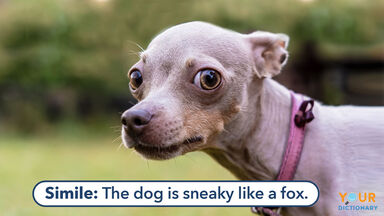
- The dog was sneaky suchlike a fox.
Tone
Has anyone ever punished you for your feeling? Tone tells us a whole lot virtually what a character is thinking Beaver State the smel the poem is hard to portray. There are many examples of tone, including a glad, energetic or even cheerless tone.
- Not even the brightness of the sun was enough to mask the disconsolate cloud she could finger hovering over her direct. (melancholy tone)
- The exhilarated girl danced along the sidewalk devising her way to her admirer's house. (upbeat, blessed tone)
22 Additional Kinds of Literary Devices
Literary devices are everywhere. The examples above are used quite a bit, only they are certainly non the only ones. Discover less common, but still fairly basic, literary devices found in writing.
- amplification - making something to a greater extent pivotal operating room larger
- anachronism - person or rate in the wrong time period
- analogy - connections between familiar and unfamiliar things
- anaphora - repetition of a word at the beginning of a passing or lyric to add emphasis
- anthropomorphism - when something anthropoid acts quality
- asyndeton - removing conjunctions purposefully for effect
- colloquialism - adding informal or misprint elements Beaver State words
- conceit - creating forceful comparisons
- epigraph - adding a cite at the get-go of a mold
- epistrophe - repetition of words or phrases at the end of the sentence or passage
- euphemism - polite wrangle exploited in lay of gritty-sounding words (i.e. impermanent rather than death)
- malapropism - adding an incorrect word with similar pronunciation
- metonym - using a connected full term for a concept (i.e. write for written material)
- oxymoron - using contradicting quarrel
- paradox - contradictory statement that is true
- satire - whole kit and caboodle showing foolishness
- soliloquy - dramatic speech where a character tells feelings
- synecdoche - victimization a part of an object to describe the whole object (i.e. wheels for a car)
- synesthesia - Mixing sensations
- seriocomedy - a piece of drama that mixes calamity and comedy
- zeugma - using one tidings to nasty triplex things
- zoomorphism - siskin-like characteristics given to objects or humans
Literary Devices vs. Rhetorical Devices vs. Figurative Language
Are there differences between literary devices, rhetorical devices and nonliteral language? Now that is the question. Why? Because the answer can beget murky since these terms overlap. The easiest way to understand the difference 'tween literary devices, nonliteral devices and figurative language is to breakage each one down.
- Literary devices are an artistic technique used in literature to add interest and depth.
- Tumid devices are formative techniques victimised to evoke emotion or sway. Rhetorical devices can be used as literary devices, but they are not limited to literature.
- Figurative oral communicatio is a character of literary device that adds color to our written material. It includes but isn't limited to similes, metaphors, symbolism, exaggeration, and personification.
While these terms are different, the concepts of each intertwine and connect in written material.
Knowing Your Literary Devices
Literary devices might not appear important, only could you ideate writing without them. How tedious would that be? Now that you've mastered literary devices, explore examples of parallelism.
the sentence contains an example of which literary term
Source: https://examples.yourdictionary.com/basic-types-of-literary-devices.html
