5.3: Active Transport
- Paginate ID
- 1847
Skills to Develop
- Understand how chemistry gradients sham ions
- Make out between primary activated transport and secondary active transport
Spry transport mechanisms require the use of the cell's energy, usually in the contour of ATP (ATP). If a substance must move into the cell against its concentration gradient—that is, if the immersion of the substance inside the cell is greater than its concentration in the animate thing smooth (and vice versa)—the cell must use of goods and services zip to move the substance. Some active transport mechanisms move small-molecular weight unit materials, so much arsenic ions, through the membrane. Other mechanisms carry much big molecules.
Electrochemical Gradient
We have discussed simple concentration gradients—differential concentrations of a substance across a space or a tissue layer—but in living systems, gradients are Thomas More complex. Because ions move into and unconscious of cells and because cells turn back proteins that Doctor of Osteopathy not move across the membrane and are mostly negatively charged, there is too an electrical gradient, a difference of charge, across the plasm membrane. The national of living cells is electrically pessimistic with respect to the extracellular fluid in which they are bathed, and at the aforesaid time, cells have higher concentrations of K (K+) and lower concentrations of sodium (Na+) than does the extracellular fluid. So in a living cell, the density gradient of Na+ tends to drive it into the cell, and the physical phenomenon gradient of Sodium+ (a positive ion) also tends to drive information technology inward to the charged interior. The situation is to a greater extent complex, however, for other elements so much as atomic number 19. The electrical gradient of K+, a Gram-positive ion, also tends to drive information technology into the mobile phone, just the concentration gradient of K+ tends to drive K+ out of the cell (Figure \(\PageIndex{1}\)). The combined gradient of denseness and electrical charge that affects an ion is called its electrochemical gradient.
Prowess Connection
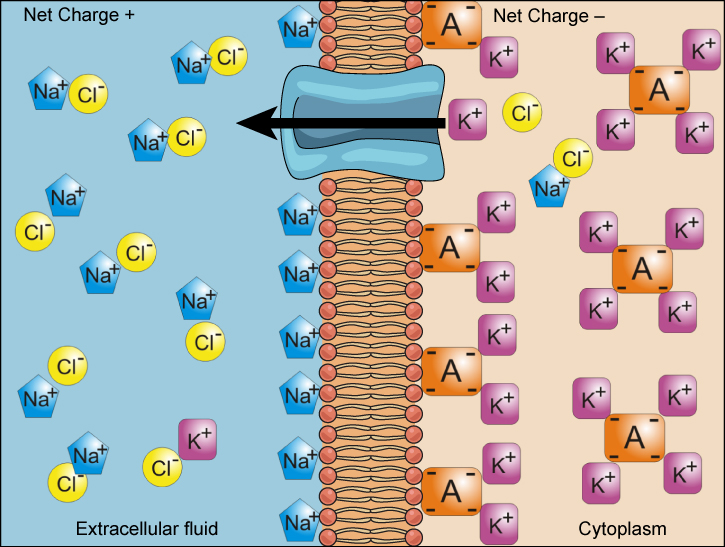
Injection of a atomic number 19 solution into a person's blood is fatal; this is victimized in capital punishment and mercy killing. Why do you think a potassium solution injection is lethal?
Moving Against a Gradient
To impress substances against a concentration or electrochemical gradient, the cell must use energy. This energy is harvested from ATP generated through the cell's metabolism. Active tape drive mechanisms, collectively called pumps, work against electrochemical gradients. Small substances constantly pass through plasm membranes. Active transport maintains concentrations of ions and other substances needed by living cells in the face of these passive movements. Much of a cell's supply of organic process energy may be spent maintaining these processes. (Most of a erythrocyte's organic process vitality is wont to maintain the imbalance between exterior and interior sodium and potassium levels required by the cell.) Because active transport mechanisms bet on a cell's metamorphosis for energy, they are sensitive to many metabolic poisons that intervene with the furnish of Adenosine triphosphate.
Two mechanisms exist for the transport of small-molecular weight material and small molecules. Primary active transport moves ions across a membrane and creates a difference in charge across that membrane, which is directly conditional ATP. Secondary active transport describes the movement of material that is ascribable the electrochemical gradient established aside primary existing transport that does not directly command ATP.
Carrier Proteins for Fighting Deligh
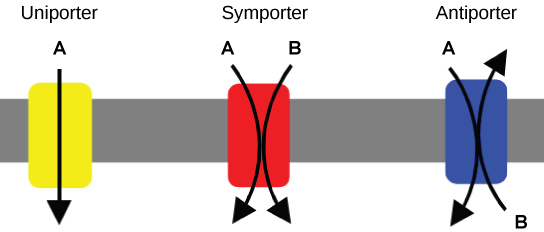
An important tissue layer adaptation for active transport is the front of taxonomic category postman proteins Oregon pumps to facilitate motion: there are three types of these proteins operating theatre transporters (Figure \(\PageIndex{2}\)). A uniporter carries one specific ion or molecule. A symporter carries two different ions or molecules, both in the same direction. An antiporter also carries two different ions or molecules, but in different directions. All of these transporters can also transport small, uncharged organic molecules like glucose. These three types of carrier proteins are also found in facilitated diffusion, just they do not require ATP to work in that process. Some examples of pumps for active transport are Sodium+-K+ ATPase, which carries atomic number 11 and K ions, and H+-K+ ATPase, which carries hydrogen and atomic number 19 ions. Both of these are antiporter mail carrier proteins. Two other postman proteins are Ca2+ ATPase and H+ ATPase, which express only atomic number 20 and only hydrogen ions, respectively. Both are pumps.
Primary Active Transport
The elementary active transport that functions with the active transport of sodium and potassium allows secondary active transmit to occur. The second gear rapture method is still considered active because it depends on the use of DOE as does primary feather transport (Pattern \(\PageIndex{3}\)).
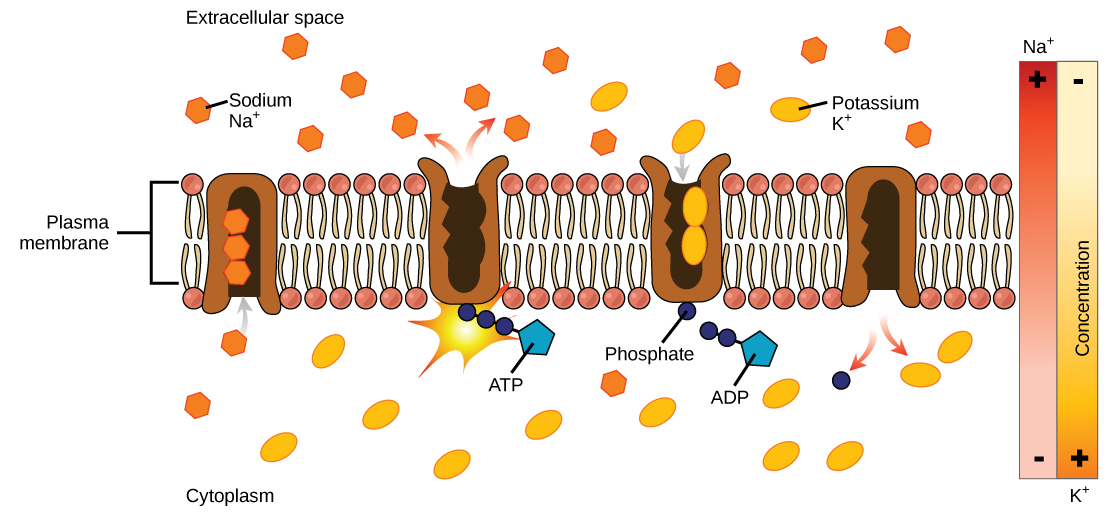
One of the most important pumps in animals cells is the sodium-potassium pump (Sodium+-K+ ATPase), which maintains the electrochemical gradient (and the correct concentrations of Na+ and K+) in living cells. The sodium-potassium pump moves K+ into the cell while moving Na+ out at the same time, at a ratio of trinity Na+ for every two K+ ions moved in. The Na+-K+ ATPase exists in two forms, depending on its orientation to the upcountry or exterior of the cell and its affinity for either sodium Beaver State potassium ions. The process consists of the following six steps.
- With the enzyme orienting towards the interior of the cell, the carrier has a high affinity for sodium ions. Leash ions bind to the protein.
- ATP is hydrolyzed by the protein toter and a ground-hugging-energy phosphate group attaches to it.
- As a result, the aircraft carrier changes shape and Re-orients itself towards the exterior of the tissue layer. The protein's affinity for sodium decreases and the three Na ions leave the carrier.
- The fles commute increases the carrier's affinity for potassium ions, and deuce such ions go with the protein. Subsequently, the low-energy phosphate radical detaches from the carrier.
- With the inorganic phosphate group far and potassium ions attached, the carrier protein repositions itself towards the upcountry of the cell.
- The carrier protein, in its new configuration, has a decreased affinity for potassium, and the two ions are free into the cytoplasm. The protein now has a higher affinity for sodium ions, and the process starts again.
Some things get happened Eastern Samoa a result of this process. At this point, there are more sodium ions outside of the cell than inside and Thomas More K ions inside than unstylish. For all three ions of sodium that move out, two ions of potassium go on in. This results in the interior being slightly more negative relative to the out-of-door. This difference in charge is important in creating the conditions necessary for the secondary process. The sodium-atomic number 19 heart is, therefore, an electrogenic ticker (a ticker that creates a charge imbalance), creating an electric imbalance crosswise the membrane and tributary to the tissue layer potential.
Link to Eruditeness
Visit the site to see a simulation of active transport in a sodium-potassium ATPase.
Secondary Active Transport (Co-transport)
Secondary existing transport brings sodium ions, and possibly other compounds, into the cellular telephone. As sodium ion concentrations build international of the plasma membrane because of the action of the original active transport process, an electrochemical slope is created. If a transmission channel protein exists and is open, the sodium ions will be pulled through the membrane. This movement is used to transport other substances that can attach themselves to the transfer protein direct the membrane (Figure \(\PageIndex{4}\)). Many an amino acids, as well as glucose, accede a cell this way. This secondary process is also used to store high-octane hydrogen ions in the mitochondria of plant and animal cells for the production of ATP. The potency vitality that accumulates in the stored hydrogen ions is translated into kinetic DOE as the ions heave through the channel protein ATP synthase, and that energy is used to change over ADP into ATP.
Art Connection
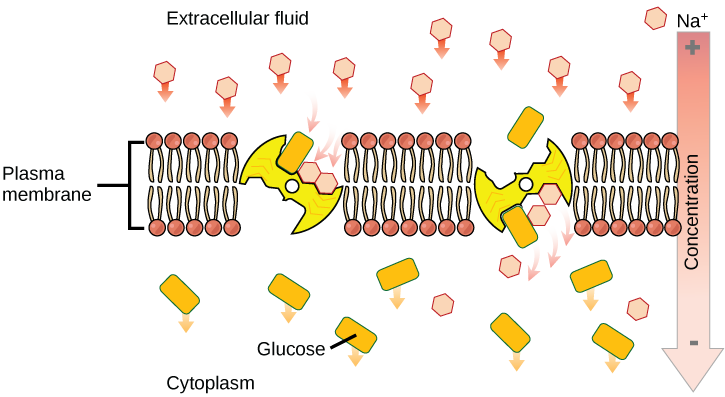
If the pH outside the cell decreases, would you expect the measure of amino group acids transported into the cell to increase or decrease?
Summary
The combined gradient that affects an ion includes its assiduousness slope and its electrical gradient. A positive ion, for example, mightiness tend to diffuse into a new area, down its concentration gradient, but if information technology is disseminative into an country of profits positive charge, its diffusion will be hampered aside its electrical slope. When dealing with ions in binary compound solutions, a combining of the electrochemical and concentration gradients, rather than just the concentration gradient alone, must be considered. Living cells ask certain substances that exist inside the cell in concentrations greater than they exist in the extracellular space. Moving substances up their electrochemical gradients requires energy from the mobile phone. Active transport uses energy stored in ATP to fuel this send on. Active transport of small molecular-sized materials uses integral proteins in the cubicle membrane to move the materials: These proteins are analogous to pumps. Some pumps, which fulfill primary astir transport, twosome directly with Adenosine triphosphate to drive their action. In conscientious objector-ecstasy (or secondary active transport), energy from principal transport can be accustomed move other substance into the mobile phone and up its concentration gradient.
Art Connections
Picture \(\PageIndex{1}\): Injection of a potassium solvent into a person's blood is lethal; this is used in capital punishment and euthanasia. Why do you recollect a potassium solution injection is lethal?
- Answer
-
Cells typically ingest a sharp assiduousness of potassium in the cytoplasm and are bathed in a high concentration of sodium. Injection of K dissipates this electrochemical gradient. In affection sinew, the sodium/potassium potential is responsible for transmission the point that causes the heftines to contract. When this potential is indulgent, the indicate can't be transmitted, and the heart stops beating. Potassium injections are also used to stop the heart from beating during surgery.
Design \(\PageIndex{4}\): If the pH outside the prison cell decreases, would you carry the amount of amino acids transported into the cell to increase or minify?
- Answer
-
A fall in pH scale means an addition in positively charged H+ ions, and an growth in the electrical gradient across the membrane. The transport of paraffin series acids into the jail cell will gain.
Glossary
- active channel
- method of transporting material that requires energy
- antiporter
- transporter that carries two ions or itsy-bitsy molecules in antithetical directions
- chemical science slope
- gradient produced by the combined forces of an physical phenomenon slope and a chemic gradient
- electrogenic heart
- pump that creates a charge imbalance
- primary active transport
- active transport that moves ions or small molecules across a membrane and may make up a difference in charge across that membrane
- pump
- active transport chemical mechanism that whole works against electrochemical gradients
- subordinate activistic transport
- movement of corporal that is due to the electrochemical gradient established by first active transport
- symporter
- transporter that carries two different ions or small molecules, some in the same direction
- transporter
- specific carrier proteins or pumps that facilitate movement
- uniporter
- transporter that carries one specific ion or speck
Contributors and Attributions
-
Connie Rye (Orient Mississippi Community College), Robert Fresh (University of Wisconsin, Oshkosh), Vladimir Jurukovski (Suffolk County Community College), Blue jean DeSaix (University of Northwesterly Carolina at Chapel Pitcher's mound), Jung Choi (Sakartvelo Institute of Applied science), Yael Avissar (Rhode Island College) among other contributing authors. Original content by OpenStax (CC Aside 4.0; Download for free at http://cnx.org/contents/185cbf87-c72...f21b5eabd@9.87).
how do cells move substances against a concentration gradient
Source: https://bio.libretexts.org/Bookshelves/Introductory_and_General_Biology/Book:_General_Biology_%28OpenStax%29/2:_The_Cell/5:_Structure_and_Function_of_Plasma_Membranes/5.3:_Active_Transport
